Japanese addresses: No street names. Block numbers.

I love learning something that flips my head upside down. So, let's look at one of the coolest head-flippers I've found: Japanese addresses.

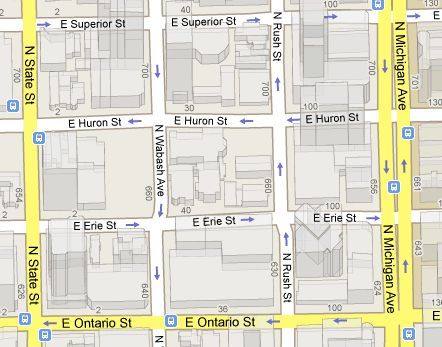
Imagine you're standing in Chicago and a Japanese man asks you, “What's the name of this block?”

map of Chicago

Thinking you've misunderstood the question, you say, “This is Erie Street. We're between Wabash Ave and Rush Street.”

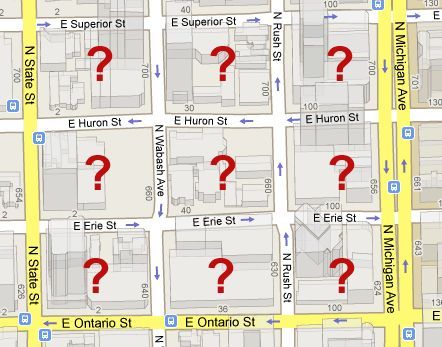
But the man asks you again, “No. Not the streets. This. (Pointing to the middle question mark on the map, below.) What's the name of this block?

map of what are blocks?

You say, “Uh. That's the block between Huron and Erie, between Wabash and Rush.”

(Blocks don't have names! Streets have names! Blocks are just the chunks of land in-between streets. Duh!)

He leaves disappointed. You shrug and continue watching the gorgeous people of Chicago.


Now imagine you're standing in Tokyo. You ask someone, “What's the name of this street?”

map of no names

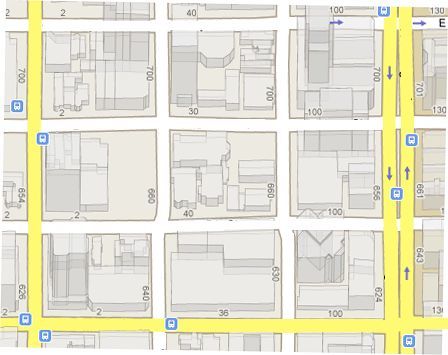
Thinking she's misunderstood the question, she says, “This is block 5. That is block 8.”

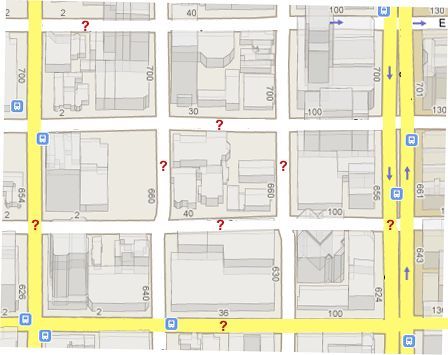
But you ask again, “Huh? No. This. (Pointing to one of the question marks on the map, below.) What's the name of this street?

map of what are streets?

She says again, “Uh. This is block 5. That is block 8.” (See the map, below.)

See: in (most of) Japan, streets don't have names! Blocks have numbers! Streets are just the empty space in-between blocks. Duh!
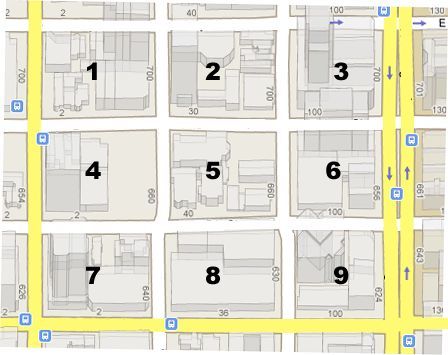
map of numbered blocks

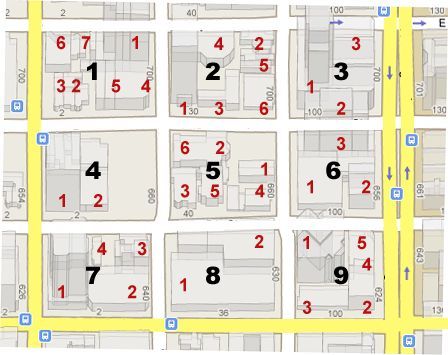
And the buildings on the block are numbered in order of age. The first building built there is #1. The second is #2, even if it's on the opposite side. So you end up with house numbers that look like this:

map of numbered houses

Mailing addresses in Japan, after naming the province and city, are a series of three numbers: district number, block number, building number. That's how the building is found. No street names.

As an example, see this Google map from Tokyo. Notice the blocks have little numbers on them: 29, 39, 38, 37, 40, 41. And the street names really are empty.
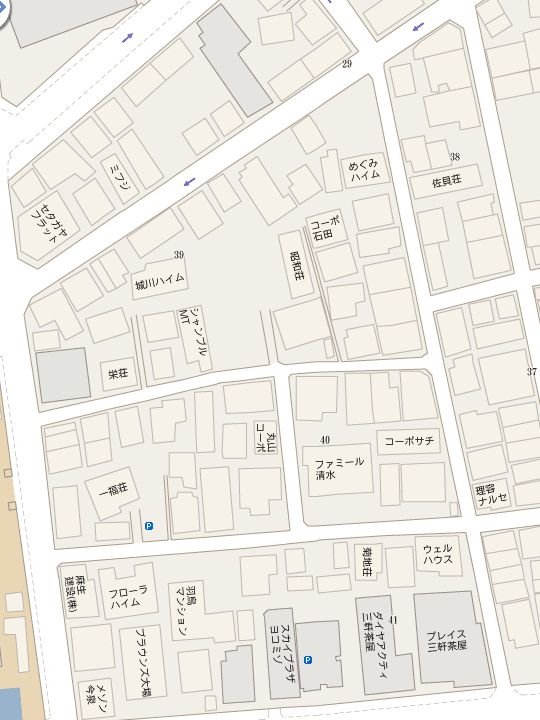
map of Tokyo

Cool, huh? You're impressed. You shrug and continue watching the gorgeous people of Tokyo.

See the Wikipedia page for the Japanese addressing system if you are interested in learning more about that.

But read “Reversible business models or leave a reply, below, if (like me) this makes you ponder what other assumptions you've been making in your life or business, that could just as easily be the opposite.

comments

  1. J.J. Vicars (2009-06-22) #

    The beauty of being an ex-pat (even if you're not too thrilled with your overseas residence) is how many basic assumptions are challenged. It's also a headache when you're back home trying to explain it to people, though now it's a little easier because you can show them pics and maps online.

    Another important difference between U.S. and Japanese street addresses is the layout of the streets themselves. U.S. cities are relatively grid-like; the streets pretty much go straight and plots are in even sized blocks. Japanese streets wind in all sorts of odd directions and some could be mistaken for alleys. The positioning of the houses on a block is equally baffling with odd shaped plots stuck in the tiniest cracks and crevices. Confusing when you're looking for something (directions must always include landmarks) but lots of fun when you're wandering around exploring a neighborhood.

  2. tania rose (2009-06-22) #

    i love how we seem to get so caught up in our own sphere of reality that a different form of logic can startle us. It's no wonder we're not yet ready to meet our neighbours in space!!!

  3. amelia Winger-Bearskin (2009-06-22) #

    this is so interesting, and sort of makes a lot of sense, man i'm going to be so lost in beijing in the fall....

  4. ade ishs (2009-06-22) #

    On one of the streets where I grew up in Jakarta, the building numbers aren't ordered.

  5. Troy McConaghy (2009-06-22) #

    These two methods of identifying (or not identifying) streets, buildings, and blocks aren't the only ones possible.

    For example, I could address my front door by its latitude, longitude, and height above sea level. People could find it using their GPS device, or by mapping it with software that can take those values as inputs.

  6. kareem (2009-06-22) #

    great post derek, thanks for sharing. the blocks vs streets contrast was a brain bender for a second - nothing like travel to help you challenge your assumptions!

    from a customer experience perspective - which system lets the customer accomplish his task easily - it strikes me that the non-japanese method of addressing homes allows people to find homes they've never been to more easily.

    i don't need knowledge of a neighborhood to know which is the oldest (or third- or fifth-oldest) building... but when i can figure out that numbers go up in one direction and down in the other, i know which way i have to walk to find the house i'm visiting.

    the same goes for blocks - a house can be located on one of 2 in the non-japanese system (probably across the street), whereas it's one of 4 in the japanese system (and you may have to do a full lap of the block to find it).

    ...or am i missing something?

    i'd also guess that very few people in japan travel to new areas without a map (be they from japan or not smile

  7. Ken (2009-06-22) #

    Japanese intra-block address number is put in clock-wise manner. If a new building appears in between two others, it is given one of its neighbors number.

  8. BlissfulJapan (2009-06-22) #

    @kareem: There are small police huts (called koban, or police boxes) scattered throughout cities that you can ask for directions at. There also are a lot more maps on the sides of roads and outside and inside the train stations. However, it's still easy to get mad when you see block 2 and block 4 but can't find block 3! Now you can see why car navigation systems and GPS are so popular in Japan, and I would argue, more useful as well.

  9. Aaron (2009-06-22) #

    I find the Japanese method avoids many problems that exist back home. Sometimes an old street will be split by a new highway. If you start your search for an address on the wrong side of the highway, you may have to make a long detour.

    In Japan, you are guaranteed to be narrowing in on your quarry. By the time you get down to the block level and have to deal with potentially out-of-order house numbers, it takes maximum 2 minutes to find the right building because Japanese blocks are reeeally small.

  10. Ali (2009-06-22) #Ali

    @jj vicars

    Depends where we're talking about. Kyoto and Sapporo are about as grid-like as it gets.

    Great post by the way, I actually was the guy asking the street names more times than I can remember!

  11. AJT (2009-06-22) #

    Huhhhh. Interesting. smile

    The wonders of another culture.

    The wonders of the west assuming its way is the right way. It's neither right nor wrong; just different.

    In Britain we have a banking franchise called HSBC who's marketing campaign is that they know all about the differences of another culture; things like this. What that has to do with banking I don't know, but I guess they mean their business advisers.

    Yeah I fell for HSBC's schtick about that. Without going into details, I can say from experience now that all it means is they have HSBCs in many countries, though each country's HSBC bank is a separate company. Disappointing. -- Derek

  12. Lynn Kerew (2009-06-22) #

    In Greece, it is totally disordered and very very confusing. The street numbers go odd/even on same side and go from 15 to 2 to 37 all next to each other! You would think Japan would run like a Swiss watch!

  13. Kevin Rees (2009-06-22) #

    Hey Derek,

    Actually, this system of addressing goes way deeper than it appears. It is rooted in Japanese culture - the concept of starting with the big picture, and then zooming in to the individual scene (prefecture, city, ward, neighbourhood, neighbourhood subdivision, block, building, apt. # and finally name), is reflected in so many aspects of Japanese society. Family name followed by given name, for example, is more than just convention. You are part of the family first, and an individual second. Company names, such as the Sumitomo Mitsui bank in English, is Mitsui Sumitomo in Japanese. I am Kevin of Osaka, but in Japanese I am Osaka-no Kevin, where the 'no' is the possessive. So, this concept is shown in the grammar of the Japanese language as well.

    Ok, maybe I'm looking at this too deeply, but there are just so many examples of this.

    Cheers,

    Kevin.

    I love it! Thanks Kevin. It makes a lots of sense to my computery brain. I like how unix dates are yyyy-mm-dd, biggest to smallest, so that when you look at a sorted list of dates they're all wonderfully in order. -- Derek

  14. ben k (2009-06-22) #

    I find the emphasis on the overall pattern of belonging rather than the single instance of first-time navigation beatiful. In an environment where repeated relationships are more common it is much more useful and harmonious to be reminded of the hierarchical structure. This reminds me a recent article on how languages affect how we think http://www.edge.org/3rd_culture/boroditsky09/boroditsky09_index.html.

  15. Jordan (2009-06-22) #

    Sooo... how would you receive directions in Japan? In the US (and most of Europe) I'd expect directions to the bank to be something like:

    "Go 3 blocks south on Main St, then turn right on 4th and go 2 blocks."

    If I asked where the bank was in Tokyo, how would they describe it?

  16. Glen Parker (2009-06-22) #

    How to turn-by-turn directions work in Japan? What directions would my GPS provide to navigate Tokyo?

    With no street names, you obviously can't turn right at K-street. Do you instead turn right after Block 32? Do the blocks have visible numbers on the corners?

  17. Lindsay (2009-06-22) #

    I just returned from Japan. I spent four days there without anything but a subway map and a list of things I wanted to see/do. I quickly discovered that having an actual street map wasn't going to do me much good! But it was difficult when people were trying to give directions. They'd say, "turn left in about 10 minutes at a 6-pointed star." And I'd be dumbfounded, trying to figure out how exactly I was going to find the 6-pointed star. Amazingly, I learned to follow my intuition... which in all cases, got me to my intended destination!

  18. Martin (2009-06-22) #

    In Sweden we have block names as well as street addresses. The street address is used by normal people to identify places, but the buildings themselves are identified by block names and numbers (for example in the land registry) similar to your Japanese example. Wikipedia has a good page about this, in Swedish:

    http://tinyurl.com/ma9gan

    Pretty good translation by Google:

    http://tinyurl.com/l8danf

    (the block names are in small text at the bottom of the street signs in the photos)

  19. David Brady (2009-06-23) #

    I love this. In programming I am always looking for alternate representations of the same data. In graphing terms, we label the edges of a graph while they label the nodes.

    Or to visualize this, we would describe a triangle as "this side, that side, and that other side, connected to form a triangle" where they would say "this point, that point, and that other point, connected to form a triangle".

    What is not immediately apparent, however, is that while the systems can be considered equivalent, they are not equal. They can be leveraged differently. Our system makes it immediately apparent that 221 Baker Street and 1221 Baker Street are connected, albeit at quite some distance, but hides the fact that 1805 Chapel Street is twenty feet away from 221 Baker. The result? In a lot of US cities we see big streets hatched with tiny "feeder" streets.

    The block-naming strategy emphasises distance over direction. You immediately see that two addresses share a common block, or ward, or city--and this also has an effect on the street layout.

    When you get your organization scheme right, it really works. Salt Lake City, Utah, is laid out on a grid, so if you are at "1300 West 10600 South" and you want to get to "700 East 3300 South", you know exactly what direction to go, what streets to take, and about how far you have to go to get there....

    But when you get your organization scheme wrong, it really stinks. Take a city that was built on the locality premise, like Boston, and then superimpose the street-names scheme on top of it, you end up with an unnavigable mess in which people still use landmarks to get around.

    Sorry for such a long comment, but the takeaway for me here is not only to see if your business models are reversible, but to ask in what ways would reversing the model make things easier--and in what ways would it make things harder?

  20. Yo (2009-06-23) #

    I'm a Japanese living in Tokyo. Our method is NOT cool. Precisely, this is cool for someone working in real estate business as the building number never gets changed once the it is allocated.

    But it's NOT cool for someone looking for a building as the numbers don't give us hints to get to the building while street names do. I've been to England for a couple of weeks, I could find buildings far more quicker.

    Finding a point (building) in a line (street) is easier than doing so in a square (block).

  21. Yo (2009-06-23) #

    I come up with the true reason why we're using block numbers: Block numbers are (usually) permanent.


    Japanese addresses need to be permanent as they are used to identify people as well. Koseki, or a Japanese family registry are searched by an address. It's literally a part of an ID.

    Details:

    http://en.wikipedia.org/wiki/Koseki

    OK. Let me conclude briefly.

    Japan takes strict "Jus sanguinis" policy. That is, to obtain Japanese nationality, you must have a Japanese ancestor. To be a Japanese, you must have a Japanese parent.

    The family registry, Koseki, is a typical method to prove one has a Japanese parent. Maintained by the Japanese government, it is a database that stores all the information including your name, your parents, your sisters/brothers, your day of birth. To be a Japanese, your record must be found in the Koseki.

    To find a record for a person in the Koseki, you use an address and a name. Japanese people don't carry IDs like social security numbers. Instead, when you really need to prove that you're a Japanese, you present an address and a name for the Koseki. If the authorities can find the corresponding record in the Koseki, you're a Japanese.

    This is the reason why Japanese prefer a permanent address. I think block number is used to make an address to be permanent.

    This may sound strange, an address for the Koseki usually do NOT represent one's residence. Updating the Koseki everytime you move is very cumbersome, most people never change the address for the Koseki in their life. One is not obliged to synchronize his/her residence and the Koseki. Instead, you can independently register your residence to the local government. Addresses for the Koseki is just like meaningless numbers in SSNs.

  22. Wash Echte (2009-06-25) #

    Wait a minute....that's...that's....Sudoku!!

  23. Marie (2009-07-04) #

    My American son has a north Korean girlfriend in Tokyo.

    We have been emailing. I asked for her address so I could send her a post card from New York City.

    Please help me to find the right format for this as it came in an email from her. I am sure it was translated, so there lots of those little boxes but this is what I got from it:

    1 10 7 404

    Tokyoto adatsiku nisidakenotsuka 404

    Thank you.

  24. sinker (2009-07-06) #

    Marie,

    It seems:

    Nishi-Takenozuka 1-10-7-404

    Adachi-ku Tokyo, 121-0822

    I have located there in GoogleMap as:

    http://maps.google.com/maps?f=q&source=s_q&hl=ja&geocode=&q=%E6%9D%B1%E4%BA%AC%E9%83%BD%E8%B6%B3%E7%AB%8B%E5%8C%BA%E8%A5%BF%E7%AB%B9%E3%83%8E%E5%A1%9A1-10-7&sll=35.793781,139.788837&sspn=0.003085,0.00537&ie=UTF8&ll=35.7912,139.788196&spn=0.001543,0.002685&t=h&z=19

  25. sinker (2009-07-06) #

    Not Nishi-Takenozuka, it's Nishi-Takenotsuka.

  26. Simon Morel (2009-07-09) #

    I love this. 3 years ago I was touring in Japan and I constantly had this headache! Where actually is the gig?!?! I get it in theory, but when I'm standing on the street, with guitar in hand, it's very different! ha ha

  27. Marie (2009-07-15) #

    Thank you so much for that information and also the link to the Google map. I am so amazed by this!

    You are very kind to help me this way!!!

  28. Japanese Words (2009-07-24) #

    Great article. Yeah it's a bit weird here in Japan. Everyone gives directions with landmarks...which is hard if you don't know the landmarks!

  29. Mark (2009-07-24) #

    I've been to Kyoto twice. All the streets had names. I believe the addressing of homes, stores, buildings etc is as you mention here (I once stayed at the Fujita hotel, addressed as Kamogawa Nijo-ohashi Tamoto in Nakagyo-ku), but the streets themselves still had names. But maybe that is a Kyoto thing.

  30. Realitybytes (2009-07-24) #

    Thank you! I lived in Japan for a decade now, and this is the first time it's been explained to me in a way I can understand!

  31. mark (2009-07-24) #

    I lived in Japan (far away from Tokyo) for two years. While the author's assertions I'm sure are accurate for Tokyo, this is not the case in all of Japan.

    In Fukui Prefecture, where I lived, probably 90 percent of the streets have names. So while this is I'm sure in Tokyo, please don't think this is the case for ALL of Japan. The author should've clarified this.

  32. Bryan (2009-07-25) #

    I'm not sure this makes much sense, with the rising of new buildings and the destroying of others.. do the numbers change in order to make sense of the new buildings? (if so I think that's a bit ridiculous), and if they DON"T change and the numerical order just goes UP as numbers have a tendency to do when counting objects.. to they have popular blocks with addresses like.. 129? or something like that? It's logical, but I don't think it's very good logic.

  33. Ben (2009-07-25) #

    Agreed with Mark. Most of Japan does in fact have street names. It's only in the very big cities that you run into this confusing block system. Even Nagoya and Osaka names it's streets (but maybe not all of them). I suspect the block system is a holdover from pre-Meji Tokyo. I've heard rumor that parts of Hiroshima has blocks too, but never confirmed it.

    I admit though. It makes Tokyo painfully confusing.

  34. Jeffrey J Davis (2009-07-26) #

    You are right, finding a specific building in Japan can be challenging. Many of the major streets in Tokyo DO have names "Roppongi Dori, etc" but by far not all. And Tokyo has very few areas of town which are remotely gridlike, with many one way streets.

    When I lived in Tokyo, the only thing that saved my bacon was that the Navi system in the car would frequently home in a building just by typing the phone number. Walking or riding a bike in Tokyo is easier and more practical!!

    But I get your point that challenging your assumptions can definitely lead you to new possibilities.


    best,

    Jeffrey J Davis

    www.jeffreyjdavis.com

  35. Charles Lloyd (2009-07-27) #

    Ha. Thats so true, I lived there for about 10 years and that is just how Japan works.

  36. Ami (2009-07-28) #

    This is absolutely amazing! I haven't lived in the US for a while now, and I've been traveling to different parts of the world. I love the challenges that you have to meet when you're out there learning knew things! The best part is, being able to find proof that the stereotypes are completely wrong! This info is just such a cool fact!

  37. B Kerz (2009-07-28) #

    My wife and I lived in Korea for a few years as well as spent time when ever we could in Japan, and it's pretty much the same in Korea, no street names except for Highways. I don't care what kind of alternate feel good explanations people want to try and place. The bottom line is no street names is lame. Forget tourists finding there way to some place new. Natives can barely give each other directions everything is navigated by Landmarks or major intersections. It's completely backwards. I've got nothing against having block and building names but no street names is just plain lame. There are so many amazing things about the culture of Japan, no street names is not one of them...

    No street names = Fail.

    -Billy

  38. jim w (2009-07-29) #

    well it sounds like a nightmare to me! i struggle with road names as it is, so i'd be screwed for sure.

  39. Kraeg (2009-07-29) #

    I found the system tricky to say the least, and once at the block finding the particular building was an exercise in frustration. One time, while looking for a sword museum, I ended up circling the block several times before finding the exact address I was looking for. And on foot - that's not a quick journey.

    Fortunately, every single Japanese person I ran into was more than happy to assist me in discovering my destination. What was more surprising is that the block addressing system seemed to leave them as confused as I was.

  40. JuicyData (2009-07-30) #

    Love it. Japanese addresses are definitely a pain for the unwitting traveler. But, Japanese police (on every second corner in Tokyo), seem to be very adept at providing directions to the ignorant. Indeed it seemed to me to be their primary purpose.

  41. Kirsty Wilson (2009-07-31) #

    What a great read and some humour beautifully added! I haven't travelled to Japan and was not aware of the address system. I will be well prepared for when I do eventually get the chance. Being an Australian, like Americans, this address system does seem odd to say the least.

  42. gigu_de_la4 (2009-07-31) #

    in Romania we have Street Names and Block Numbers ...

  43. Lynne (2009-08-01) #

    Thanks for this. I'm British, and beyond the age of about 4 we don't even have blocks, so doubly confusing.

    I'm going to use this on my students for giving directions. smile

  44. Daniel (2009-08-01) #

    Nepal now has street names and numbers, but they only got them fairly recently and not many of the locals know the names/numbers.

    There addressing system was previously just based around land-marks, they didn't even use numbers!

    If you want to go somewhere in a taxi, you usually have to tell the taxi driver the old-style landmark the area is based around and then he'll drive you around looking out the window for the place you want to go.

    It can be very confusing.

  45. dm (2009-08-01) #

    so, if I work for the city planning commission and a street needs to be repaired, how do we designate which one will be repaired? smile

  46. Mark K (2009-08-02) #

    amelia wrote "this is so interesting, and sort of makes a lot of sense, man i’m going to be so lost in beijing in the fall…."

    which I found to be funny since Beijing is in China and this is blog on Japan!

    YES amelia you are going to be REALLY lost! LOL

    but dont' feel bad, I have been to Beijing and the taxi drivers frequently have to pull over for directions........

  47. Gymnastics Leotards (2009-08-02) #

    Great article!

    Having lived in Japan this is only part of the story. Usually the numbers are written in Japanese characters and not the digits we are used to so even if you get to a place you can't read the number on the building (if exist at all) before you learn the Japanese (Kanji) letters representing the number 1-9.

  48. Joe (2009-08-02) #

    Interesting not a head-flipper though, Let alone one of the coolest.

    C'mon Joe. Offer up a better one, then! -- Derek

  49. hepkess (2009-08-03) #

    I live in Japan and this is what I have learned about this topic from the Japanese I have talked to over the years. The streets in smaller towns are built in no particular grid so as to confuse invaders, these would be people from other districts when everyone didn't get along so well. (feudal lords, masterless samurai, etc.) The larger cities, especially the downtown areas, were extensivly bombed by the USA during the war. During the occupation, the roads and streets were put into the grid patterns. (I live in Sendai, Miyagi in the northern part of the main island, Honshu.) In Kyushu, the southern island of the main group, words were actually given opposite meanings so it was easier to spot a spy.

  50. kiki (2009-08-03) #

    Loving how this system has survived modernisation. I can't help wondering how frustrating it must be for for postmen though!

  51. Anna Cortez (2009-08-04) #

    I used to joke that it would be a lot easier to find places if they had a unique number. Now I know there is a country which does just that. There is an old folks home one mile mile away -in fact it's a Christian retiral vilage with its own lake and is quite beautiful. A special bus I had booked went there by mistake but found me eventually so there is something to be said about numbers. The Japanese people are lovely as well as clever. Maybe we sould take a leaf out of their book. I speak from experience. Thanks for having this page up Derek -I learn something from you yet again without even having to leave my modest little home. Thank you so much!

  52. Jane (2009-08-06) #

    I love this article! I have lived in Japan and often struggled with directions. I found most people don't use the block numbers and refer to rivers, buildings, train stations, etc. to give directions.

  53. Phil (2009-08-06) #

    Great article! Japan should be on everyone's places to see before you die list: http://www.ranker.com/list/places-to-see-before-i-die/drxavier

  54. Topher (2009-08-17) #

    Denver, Colorado has a street naming convention that really threw me when I first got here: street names extend all the way north/south or east/west, even if the street does not. Thus "Daniel Street" may appear in one long stretch across town, while "David Street" is broken into dozens of little snippets -- but they'll all be lined up with each other either n/s or e/w. Once understood, the system works very well, but the first time you try to find a street on the map can leave your head spinning.

  55. Debbie (2009-08-21) #

    I work for the USPS. A few years ago we had a guy from Japan work for us briefly I might add. He had a really hard time delivering mail here. He couldn't catch on to the numbering system here. Now I understand why.

  56. radono (2009-08-26) #

    good fery 2 good

  57. marie (2009-08-31) #

    Thank you again! My postcard from New York City reached my son's girlfriend in Tokyo with the address help I got here! I was thrilled to send off an actual piece of mail while on vacation vs. email. Something to handwrite, send something real. Electronic is great, but a personal touch is nice too sometimes!

    Thanks again.

  58. Tangent (2009-09-04) #

    You think that's weird, in San Francisco they don't use exit numbers!

  59. Bill Hochberg (2009-10-09) #

    Just returned from Japan myself. It was explained to me by a few Japanese that this system -- which most of them don't like either -- was devised during the Shogun era as a way of confusing their enemies, so no one would know where anything is... trouble is in many cases not even the cab drivers know where anything is. they can only drop you off on the block somewhere and leave it to you to ask for further directions... Its one of the many wild ironies about Japanese cultures that you HAVE TO BE on time to your meeting, but it is soo hard to find anyplace not located at a major intersection. Give yourself double the amount of time you think you need to get there on time.

  60. Mark Gresham (2009-10-09) #

    The important thing I took away from reading this is how it related to your most recent essay of today (2009-10-09) "How do you grade yourself?"

    The question is raised: How does our perceptions and measurements of our environment affect the manner in which we measure our selves? And vice versa.

  61. Zack Kline (2009-10-10) #

    So very interesting and assumption-challenging, Derek. Your other post about how bands might try flipping around the assumptions we usually have selling CD's has also gotten me thinking about music teaching. I wonder what could happen if I started offering the classes, like a Fiddle Ensenble, which I really WANT to teach and let people pay what they could. It may or may not work, and the biggest problem might be people taking advantage of it, but, I am continuing to ponder it and want to try it out when the time is right.

  62. Steve (2009-10-13) #

    This is good to know. I wondered about all of those numbers.

    I've also been wondering if there are any nations that actually use GPS coordinates or lat/long. It would sure make finding places a lot easier. And with zip+4, now at 9 digits, you could have the actual position in 12 digits.

  63. Alan Merrill (2009-11-28) #

    When I first got to Japan in the summer of 1968 I didn't leave the hotel (the Tokyo Okura) without a map of my location written in Japanese. I made it a point to have knowlege of a few words. "Left, right, stop, thank you, please, and straight ahead." There weren't many foreigners living in Japan at that time so I was looked upon with great curiosity. A foreign teenager with a Rolling Stones hair style in 1968 was something most Japanese had only seen in magazines and on TV. Before I even had made a record there, girls would scream and run after me in the street thinking I must be part of a famous British band. To be honest, I loved the attention.
    Things got even better when I got a record deal in the winter of '68 and started touring there. There are so many towns to tour in Japan, and back then in many they had never even seen a foreigner except in the media.
    As you say, in Tokyo the addresses were defined by blocks, and bridges, which were pedestrian walkways to help traffic move more smoothly.
    I left Japan in 1974 to live in London, missing the Japan fiscal "boom" by a year or so. Bad timing, but I'd had my fun and was a pioneer in the music world there as a foreigner in the local Japanese scene, the only gaijin accepted in the Group Sounds circuit.

  64. Betsy Grant (2009-11-28) #

    Well, fortunately, I put such a high estimation on growth and learning that I've pretty much set things up so that my subconscious begins to look for assumptions that are limiting if I'm not growing and moving forward in my life. One's system of values is everything in life!

  65. Margaret Bernstein (2009-11-28) #

    You are on a roll these days Derek!!!
    Anyhow, you always have something interesting to share with us. Thanks for keeping the inspiration going! I hope to see you/talk to you in person soon!smile

  66. Traveler (2009-12-10) #

    Speaking from 20+ years in Japan: Yes, the block system is interesting; nice to see an overview here. But if I may send a friendly note to commenters overall: let's not go overboard with the "ooh, how unique!" bit, or contrived cultural explanations. Cities or neighborhoods that developed as mazes of twisty, splitting streets can be found all over the world, and a street-based address system won't work well in those. (For the record, too, streets of reasonable size *do* have names in Japan, though it's true that those aren't used as the base of addresses, even in Japanese cities or neighborhoods that are laid out grid-like.) It's all interesting stuff, but not unique to Japan.

  67. msimswil (2009-12-13) #

    dm asks: "if I work for the city planning commission and a street needs to be repaired, how do we designate which one will be repaired?"

    Every scrap of land is recorded as an entry in the land register. This is a separate recording system from addresses; the address of my house is a series of progressively more detailed information, and its land registry entry is a similar (but not identical) data set.

    Streets, hillsides, quays, etc. - nothing escapes the land registry, because every square meter belongs to someone.

    To answer your question, dm, your office would probably use the land register designation to specify the works area, and print out lots of very detailed maps.

  68. makkoho (2009-12-18) #

    Nice - that's something new I've learned today - thanks!

  69. Japanese phrases (2010-01-28) #

    Even after living in Japan for a while it is still pretty weird to have block numbers. Here in Okinawa there are a few more street names however.

  70. slebetman (2010-03-16) #

    You think Kevin's explanation of Japanese grammar is similar to unix date format (yyyy-mm-dd)? Well guess what, yyyy-mm-dd is how the Japanese commonly write Gregorian dates (actually more like yyyy年mm月dd日).

  71. Cornbred (2010-03-26) #

    While visiting in Akita recently, I asked a friend how was it possible to use a GPS Navi. He said you need to go to a place first, then the Navi. will get you there from most anywhere. Not so convenient, but I can't wait to go back!

  72. Chris K (2010-04-05) #

    It's funny you used Chicago as the example map - it does (did) use blocks, as seen here: http://www.encyclopedia.chicagohistory.org/pages/11175.html Block 37 is very well known locally actually.

  73. Lloyd (2010-04-15) #

    Looks like this is how Sudoko puzzles were developed!

  74. danielle (2010-04-15) #

    hahah kinda looks like sudoku

  75. Ruth Ferez (2010-05-10) #

    Only thing is on Google maps the numbers are written in Japanese. *Duh*

  76. Janet (2010-05-11) #

    If the houses are numbered by age, what happens when an old building is torn down and then a new one built on that plot of land?
    Example: Building 1 (the oldest one) is torn down. There are 5 buildings on the block. So is the new building still #1 (the newest building is now coded as the oldest) or is it #6 and there is no longer a #1?

  77. jason lu (2010-06-25) #

    it is simple - the logic behind it is since in the old time the land is much bigger, emptier & people usually use important building for landmark & tradition just keep pass down. So even now they have section up into small block by the streets still carry the traditional way, This system is only good for the people who grow up in the area so they slowly memorize the landmark... luckily there is google map now.. imaging to look up one building's name in Tokyo

  78. Hugo (2010-06-30) #

    I live in Japan and I didn't know they were numbered by age...

    Just to make things clear: The major streets of cities have names. I live in Wakayama-city and we have Chuo Dori (Chuo means central and Dori street) and Kokutai Doro. (I think it's national road. We also have Keiyaku Dori, named after a type of tree bording it.

    Anyway, most streets have no name (as in the U2 song) and it is confusing as hell to find a house with the address. Some streets are so narrow, a car cannot pass. YOu should see my neighborhood.

  79. Tarrou Abbye (2010-07-31) #

    When you're lost in many cities of named streets without a map and where few passersby can understand you, if you're two streets off, you might never know your destination was just around the corner. In Japanese cities, you can usually circle in on your destination with just a few numbers and a neighborhood name. As a walker and foreigner, it's a fantastic way of getting comfortably lost in a strange land. If you enter a new neighborhood, you know you need to go back. If the numbers are going the wrong direction, the same thing. Sometimes the building, your physical destination, will be hidden, but because all of the other numbers are right, you'll know you're not truly lost. And upon finding your destination, if you've found it on your own, you might feel some of what jungle explorers of the past felt finding their hidden city in the mist.

    There are also maps everywhere and more than a few helpful people.

  80. Mattie Hitsugaiya (2010-08-26) #

    You have the system down. I live in Tokyo, and I've gotten so used to the system here that when I went to Philadelphia to see the rest of my family, I was asking people for a block number! They told me that I was in the wrong country, and that we have street names, not block numbers. I was sooo embarrassed!!

Your thoughts? Please leave a reply:


  (kept private! never shared.)


Derek Sivers